
There is no one right way to do a retrospective, there are many good techniques...and a few bad ones. Utilizing more than one technique is a good way to get different conversations going with your team, and expose different areas that could use a little fixin'. That said, I do have a "tried and true" technique that we've used on a number of teams over the years. It's usually pretty good at getting the conversation going, and can be done in 30 minutes or less to keep you from being stuck in "yet another meeting."
First things first, at the start of any retrospective you should review the action items or results from the previous iteration's retrospective. Have the people assigned to each item report how it went and what got accomplished. Nothing gets a retro off to a good start like saying, "Remember that problem we had last week? It's fixed!"
A Few Supplies and a Little Preparation
We're going to need:
- Three colors of sticky notes. Regular square ones will work fine. For this example we're going to use purple, yellow, and green.
- A box of pens, preferably all the same kind. I like to use sharpies because big pens on small paper ensures we get short items on each card rather than essays. Using the same pen also keeps things a little more anonymous.
- A whiteboard. In the absence of a whiteboard the big easel sheets would do the trick.
- A timer of some kind. I picked a timer up for about $200...it also makes phone calls, surfs the web, plays Angry Birds and sends text messages and email. It's high end for a timer, but it does the trick.
For the prep work, take our three colors of sticky notes and split them up so each member of the team has a few of each color. The number really doesn't matter, but we usually end up with 6 to 8 of each color for each person. Give each member of the team their own little pile of sticky notes and a sharpie.
Gather The Data
The colors signify good, bad, and confusing items from the previous iteration. Since we went with purple, yellow, and green we'll say that purple = pain, yellow = confusing, and green = good. Set the timer for 5 minutes and have the team write as many items as they can think of for each color from the previous iteration. They should do this on their own, writing their own thoughts down, we'll collaborate and discuss later. If your team is smaller and iterations are pretty short, put less than 5 minutes on the clock.
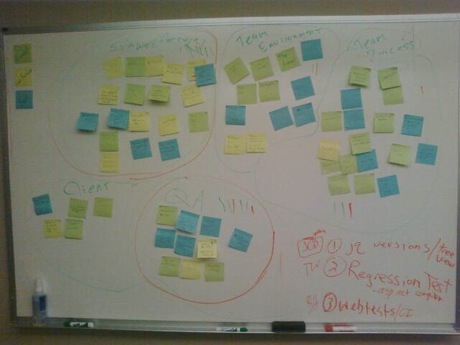
When the time is up, have each team member walk to the white board and stick their notes on the board. No order to them, just get them on the wall. Once all the stickies are on the wall, take a couple of volunteers to group them by subject, not by color. We're not looking for all the bad things that happened in one cluster, we're after what was good and bad about a given subject to the team. Aim for 4 to 8 categories, and try not to get them too broad. Once you have your categories, circle them and put a one or two word title above the cluster. It should look something like this...
Discuss
We've got things broken down, next up we have to decide what we're going to tackle. Best way to do this is to Dot Vote. Dot voting is an old stand by in agile. Each team member gets 2 or 3 votes and they place a dot next to the category they want to discuss. If they think a category is very important they could put all three of their dots next to that category. We do want each team member to use their votes though, abstaining isn't allowed.
When everybody has voted we'll discuss the top two vote getters and try to pull an action item or two out of each category. Do a quick run through of each sticky, set the timer at 10 to 15 minutes, and get to discussing. Try to involve everybody in the discussion as well. Since everybody contributed to the stickies on the wall it should be easy to get the quieter folks to speak up as they likely added a note to the category.
What Are the Goals Here?
Goal numero uno in this set up is to get everybody to put stickies on the wall with what they thought went good or bad or confused them during the last iteration. By doing this we have everybody involved in the retrospective right away, and increases the likelihood of them speaking up during the discussion.
The second thing we're after is discussing categories of issues rather than smaller issues raised by one person. The goal of any retrospective is to look back and see what we can do to make the whole team better, not just what the loudest, type A personality, Alpha-Dev wants fixed to make his life better. By categorizing everybody's issues we can compare what everybody thinks, discuss the broader issue, and derive a good actionable, assignable action item from that.
Some Issues: Learn From My Mistakes
Doing this, or any, retrospective style 6 or 8 or 10 retrospectives in a row will stop yielding good results. That happened with one of my teams and we kind of got in a rut. Once in that rut the retrospective became an "Airing of Grievances" (minus the festivus pole) and we weren't getting good action items. In reality, we were getting bad attitudes towards the retrospective and incremental change was not coming our way.
One particular retrospective we had done the categorizing and completed our voting and a sticky note from one member of the team had not made it into a category we were going to discuss. In order to get it discussed, the owner of the sticky moved it into a category we were going to talk about. It was posed to the team if we should leave it, and the consensus was it wasn't there for the voting, it shouldn't go in now. The offender wasn't too happy with this decision and slapped it back in to be discussed...at which time one of us removed it, tore it up, and threw it away. Team over individual in the retro. Always.
As noted earlier, and solidified with my first issue above, this isn't the only way to do a retrospective and it shouldn't be used iteration after iteration. However, it does get the conversation going and it will usually yield an item or two that your team wants out of its way. Give it a shot the next time you have a retrospective.

 It’s moved around Columbus to different places. Started out at Polaris, held in Dublin a couple times, and we’ve had a pretty regular group at Stauf’s in Grandview since last November. I’ve lost track of the number of new faces that have showed up at our little gathering, but there are a few – like